Saturday, January 4, 2014

Historical News and Notes: Miss Marshall Bride of Welsh Strawbridge

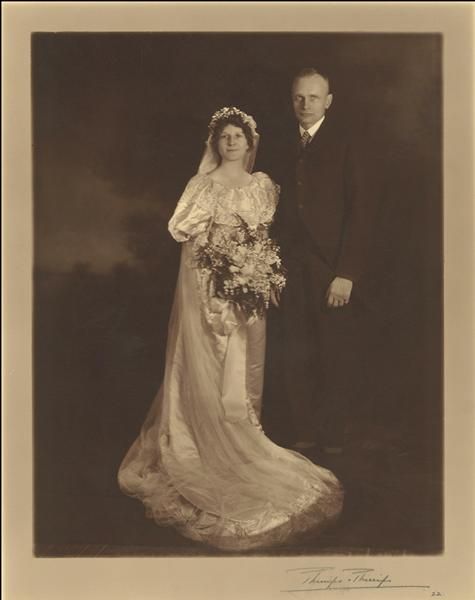
Margaret and Welsh's wedding photo.
Courtesy of the Horsham Preservation & Historical Society

The following announcement appeared in the January 4, 1922 Evening Public Ledger.

Marriage Took Place at Noon Today in Calvary Presbyterian Church

A wedding of social interest took place at noon today in Calvary Presbyterian Church, Twenty-First and Walnut streets, when Miss Margaret Ely Marshall, daughter of Dr. and Mrs. George Morley Marshall, of 1819 Spruce street, became the bride of Mr. Welsh Strawbridge, son of Mrs. George Strawbridge, of 6711 Wissahickon avenue, Germantown. The ceremony was performed by the Rev. James B. Williams of Cleveland, O., uncle of the bride assisted by the Rev. Alexander MacColl. The bride, who was given in marriage by her father, was dressed in an old-fashioned gown which had been worn by her mother. It was of ivory white satin, and point lace, with a full skirt, puffed sleeves and short, pointed bodice. Her tulle veil was arranged with a cluster of orange blossoms and she carried a shower bouquet of lilies of the valley and white bridal roses. Mrs. Stephen G. Kent, sister of the bride, attended as matron of honor. She wore an old-fashioned frock of jade green taffeta and a cap-shaped hat of jade green tulle and silver, trimmed with a plume of the same shade. She carried a bouquet of Sunset roses.

The bridesmaids included Miss Celia Marshall and Miss Harriet Marshall, sisters of the bride, and Miss Alice Welsh Sailer and Miss Louise Strawbridge, cousins of the bridegroom. They were attired in frocks of taffeta shades of sunset yellow, orchid, maize and turquoise blue and carried bouquets of Sunset roses. Mr. John Strawbridge, brother of the bridegroom, was the best man, and the ushers were Mr. H. Morris Adams, Mr. Russell H. Johnson, Jr., Mr. Robert F. Welsh, Mr. Thomas Stokes, Mr. John W. Stokes, and Mr. Stephen G. Kent.

A small reception followed the ceremony at the home of the bride's parents for the relatives and a few intimate friends.

The Library of Congress has made historic newspapers dating from 1836-1922 available through their Chronicling America series.

Tuesday, December 31, 2013

Happy Hogmanay!

From the Reformation in the 16th century, up through the middle of the 20th century, Scotland did not officially celebrate Christmas. Through the 1960s schools and work places were open and mail was delivered. Paradoxically, it was for religious reasons that Christmas was removed from the calendar –Protestant reformers saw it as a Catholic, or Papist, tradition.

What the Scots did celebrate was Hogmanay, or New Year’s Eve. Up until 1600, New Year’s Day was March 25. Forty years after Christmas was removed from the Scottish calendar, New Year’s was moved to January 1 in order to “bring Scotland into line with other civilized European nations.” By moving the New Year, Scots were able to have a winter holiday and it took the focus off of Christmas.

Hogmanay was brought to Scotland by Vikings in the 8th and 9th centuries as a celebration of the winter solstice. To properly celebrate, there are several traditions or superstitions that need to be taken care of. These include cleaning the house, taking out the ashes and clearing all your debts before “the bells” sound midnight on December 31: the underlying message being to clear out the remains of the old year, have a clean break and welcome in the New Year. Immediately after midnight it is tradition to sing Robert Burns’ “Auld Lang Syne.”

Once the business left from the old year is taken care of, the festivities to welcome in the New Year begin. An integral part of the celebration is to welcome friends and strangers with warm hospitality. “First footing” (or the “first foot” in the house after midnight) is still common across Scotland. To ensure good luck the first foot should be that of a dark male, and he should bring symbolic pieces of coal, shortbread, salt, black bun and a dram of whisky. The dark male is believed to be a reference to the Viking days, when a big blonde stranger arriving on your doorstep was not a good omen! The traditional celebration involved dressing up in the hides of cattle and running around the village while being hit by sticks. Animal hide wrapped around sticks and ignited produced a smoke that was believed to be very effective in warding off evil spirits: this smoking stick was also known as a Hogmanay. Today the festivities still include parading through the streets with torches and lighting bonfires.

Saturday, December 28, 2013

What Is It? Where Is It? (December): The Redware Plate Found in the Dining Room


This month's "What Is It? Where Is It?" is a piece of the redware plate that was found underneath the floorboards in the dining room of the Keith House in July, 1991. It is currently on display in the Visitors' Center. I was unable to confirm why the floorboards were removed in 1991 - the floor in this room was actually replaced in 1969 when the state was doing restoration work, so it is a mystery why the plate was not discovered then.


Redware is a type of pottery that was common in the 17th and 18th centuries and made with the red clay that is abundant in southeastern Pennsylvania (as well other places). It was cheap to produce because the materials were available locally and was fired at a lower temperature than other, harder potteries. It was very common among the German immigrants in this area. This piece is considered "slipware" or decorated in "slip." The pattern is made by mixing clay with other minerals and water and then squeezing or painting this watered down mixture onto the red clay body before firing. Original glazes often contained lead.

Another common decorating technique is sgraffito, in which a solid coating of slip (the watered down clay mixture) is applied to the redware and then a design is scratched into it (the word comes from the Italian verb sgraffire, which means "to scratch"), revealing the background layer and color. Both techniques can be executed in layers and with multi-colored and complex designs, making this utilitarian pottery a true art form which is still created to this day using the same techniques used by artisans 300 years ago.


To review all of the "What Is It? Where Is Its" from the year, click here.

Related Posts Plugin for WordPress, Blogger...